
Could An EMP Event Kill Bitcoin?
By Olde Salt

Chapter One—Solar Storms
I have a dear friend of many years (we’ll call him Stan) who is a fervent, level-headed preparedness guy—a serious and sober “Prepper.” Stan is leery about owning bitcoin out of concern it might be vulnerable to damage or destruction from a large Electro-Magnetic Pulse (EMP) event.

I promised Stan I would do some research and send him a bit of written guidance on the subject, and I quickly realized other Bitcoiners, and Preppers for that matter, might find such information useful.
Hence this paper, the goals of which are to teach Preppers some Bitcoin and to teach Bitcoiners some Prepper. I do this because Preppers, in general, are great folks who share many of the important values of the Bitcoin world but have not yet incorporated Bitcoin into the bigger picture. If Peppers come to understand Bitcoin, each community will benefit. If Bitcoiners come to understand preparedness they will benefit. Broadly stated, we can help them and they can help us.
Chapter One of this paper will define EMP’s in general and examine the effects of EMP’s caused by severe solar storms.
Chapter Two will examine the effects of a gigantic EMP that would result from the detonation of a high-altitude nuclear weapon.
Chapter Three will examine the title question—Could An EMP Event Kill Bitcoin?
So, let’s begin with a bit of science.
Science Fact One.
In 1831 British scientist Michael Faraday discovered that moving a magnetic field past an electrical circuit causes current to flow in the circuit. And if the magnetic field is very strong and it is moving very fast, it will induce a very large pulse of current that can damage and even destroy the components of circuit.
Two factors are important here, a) this effect only applies to circuits and b) the physical length of the circuit matters. When long expanses of metal, acting as gigantic antennas, are impacted by large magnetic fields, large voltages can be created in the metal structure. If the structure is freestanding however, no current will flow. If the structure is normally part of a circuit, such as electrical power transmission lines or large antennas, large electrical currents can flow potentially damaging devices that are connected to that circuit.
Science Fact Two.
The Earth is a big magnet covered by a thick blanket of air. Part of that blanket, from about 30 to 600 miles up, called the ionosphere, is essentially an electrified soup. The magnetic field and the electrified air constantly interact affecting the propagation of radio waves in space and on the ground below. This interaction causes the Northern Lights. Even the temperature and thus, the density of the air, are regularly impacted.
Science Fact Three.
When a solar storm occurs on the surface of the sun, clouds of charged particles and waves of magnetism are shot off into space. Occasionally, these effects reach the Earth and physical chaos can ensue.
With that science in mind, let’s bring back to life the worst solar storm of the past hundred years and replay that event in the current day. In 1989 the entire province of Quebec in Canada experienced a nine-hour power outage including the city of Montreal when the Hydro-Quebec dam was knocked off-line by the solar storm. As a thought experiment, let’s transpose that event to today and to the largest hydro-electric dam in the United States.
The Grand Coulee Dam, 230 miles east of Seattle, Washington, provides electrical service to eight states in the western part of the country. Measured in miles of wire, Grand Coulee operates one of the largest and longest power transmission systems in the world.
If a series of extreme solar storms strikes that transmission system, Seattle, Tacoma, Olympia, and Spokane, Washington— combined population over 5 million—could be rendered powerless for several days while workarounds are implemented and repairs are made to the system.
Throughout the system, small components attached to the transmission lines, such as insulators, sensors, relays, protective components, and control mechanisms might be destroyed or disabled and large components, such as transformers and substations could be damaged. Power grid infrastructure over a very wide area would also be susceptible to damage or unintentional shut down
One very important lesson was learned from the 1989 Quebec outage. The damage from the storms was limited primarily to the electrical power infrastructure. No significant damage was reported to homes, office buildings, industrial facilities, airplanes, trains, buses, or automobiles.
But power outages would not be the only problem. Interactions between the storm and the ionosphere will disrupt radio signal propagation in the High, Medium, Low and Very Low (HF, MF, LF, and VLF) frequency bands affecting shore-based communication, navigation, and emergency systems used by military and civilian ships and aircraft. VHF and UHF will likely not be seriously affected because their antennae are much shorter and their operation is not dependent on atmospheric conditions.
Brief Note: Ham Radio operators should probably disconnect their long antennas until the storm passes by.
And then there are the satellites.
In 1989 there were fewer than 200 satellites in orbit around the Earth. Today there are thousands and that number increases almost daily. Elon Musk’s Starlink system alone currently operates about 9,000 satellites and future plans are in place for 20-30,000 more (!). Other state and corporate actors are adding still more to the mix.
Modern satellites are essentially fancy computers operating an array of sensors and outfitted with communications devices that can talk to the ground and other satellites. Ground stations interact with these satellites constantly, controlling their orbits, tasking the sensors, and processing/downloading the collected sensor data.
Strong solar storms can disrupt or distort most functions of the satellite constellations. In recent storms, GPS, communications, research, weather observation, military and other satellite services became unreliable during the storms and afterwards until system corrections could be made.
Even more seriously, changes in the density of the electrified air can slow down low-flying satellites creating enough to drag them uncontrollably to destruction in the lower atmosphere. For example, in 2022 Elon Musk’s SpaceX company lost 38 satellites at one time due to orbital degradation caused by a severe solar storm.
In summary solar storms are for real and they can indeed cause problems in the sky above and on the Earth below. There has been, however, significant progress since 1989 in the development of technologies to protect satellites and large power infrastructure from solar storms. Even though improvements have been implemented, recent storms have clearly shown that satellites are still susceptible to disruption.
Even so, preparedness for these problems seems wise and, in this regard, the Prepper community is definitely on the right track. For instance, I agree with them that an emergency generator with fuel and the storage of at least several weeks’ supply of food, water, medicine, and other necessities is perfectly reasonable.
I would add one further word of caution. If your livelihood depends on services from satellite systems such as GPS, realize those services could indeed be disrupted by a solar storm.
For Bitcoiners:
I hope this chapter has provided a bit of insight into some of the concerns of the preparedness community. Much of what they propose makes good sense. For example, power was lost over a broad area in North Carolina and surrounding areas following hurricane Helene last year. Operation Bitcoin helped to collect disaster relief funds for the victims of that storm and, well before FEMA arrived, the Bitcoin Veterans group delivered food, generators, fuel, and radio communications gear for weeks following the storm.
Most Bitcoiners are advocates of strong families and self-reliance and are keenly focused on the future. Preppers hold these same values. It seems obvious to me that they are our natural allies and have much to teach us. We likewise have much to teach them.
For Preppers:
I hope this analysis of the potential impact of solar storms is useful to you. I don’t think you need to do anything in addition to the steps you are already taking to protect yourself and your families against a broad range of natural or man-made disasters such as wildfires, tornadoes, earthquakes, and flooding. Solar storms should certainly be on your list, but I would place them down below many other calamities.
At first, it might not seem obvious, but Bitcoiners already passionately believe in most of the core values of your community. And we believe we have much to offer you in the realm of money and finance.
Meeting in the middle just seems like a good idea.
The next chapter of this paper examines the impact of the Godzilla of EMP’s that would result from the detonation of a high-altitude nuclear weapon above the United States.
Chapter Two—Nuclear Weapons
Mankind has far outdone Mother Nature in the large EMP business—nuclear weapons. A nuke detonated at high altitude will generate a High Altitude Electro-Magnetic Pulse (HEMP) strong enough to disable or even destroy electrical grids on the surface below but without killing people or destroying structures. The destruction of electrical grids could be catastrophic and is of great concern to the Prepper community.
In 2010 the U.S Army conducted a study to determine the extent of damage to electrical grids from a possible HEMP attack. As seen from that report, as displayed below, the altitude of a detonation determines the size of the area affected.
A burst sufficient to affect electrical power over most of the United States would require detonation at an altitude around 400 kilometers (about 250 miles). In the bargain, such a blast would also impact large portions of Canada and Mexico.
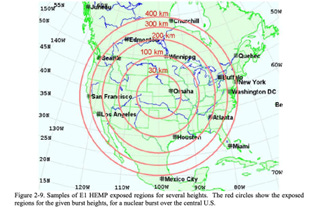
A detonation at this altitude, however, produces a significant but relatively weak EMP that would probably not deliver a “killer” blow to the country. Multiple blasts at 100 miles or so would be needed to get that job done.
But there is more. Much, much more.
As bad as the surface effects of a HEMP attack might be to the electrical power infrastructure of the country, that is by no means the extent of the potential damage. The impact on satellites in space would be equally serious. Here is the Parade of Horribles:
★ The HEMP itself would destroy or disable many of the satellites within the line of sight of the detonation—below, above, and to the sides of the blast.
★ The massive burst of x-ray and gamma ray radiation and charged particles resulting from the detonation would damage even more of the satellites in the line of sight.
★ The interaction of this intense radiation with the Earth’s magnetic field and the upper atmosphere would create an artificial radiation band around the Earth that could last for months, even years. Thousands of the remaining functional satellites would have to pass through this toxic environment multiple times a day as they complete their orbits. Eventually many more satellites would degrade and eventually die before their intended lifespan.
★ As damaged and destroyed satellites lose their orbital stability, uncontrolled collisions would occur destroying even more satellites and creating massive clouds of space debris which would create even more destruction. Eventually, most of the entire satellite ecosystem would be rendered useless.
Here is an excellent article that details such a collapse.
Three adversarial nations are known to possess nuclear weapons and the means to deliver them into the atmosphere above the United States—Russia, China, and to a lesser degree, North Korea which, from a nuclear perspective, is a closely-controlled Chinese proxy.
Pakistan does have nuclear weapons but uses China for satellite launches. India has both nukes and launch capability but is considered neutral to friendly. United States allies France, Great Britain, and possibly Israel are the remaining members of the Big Boy club. Iran is certainly adversarial but has neither nukes nor launch capability.
It is key to understanding the HEMP problem to recognize that only China and Russia constitute the real threat.
Overall space activity is much more extensive than is generally recognized. Active nation-state participants in designing, building, launching or operating satellite systems include at least US*, China*, Russia*, EU*, Japan*, Canada*, India*, Brazil, South Korea, Italy, Australia, Iran, Poland, Oman, UAE, Saudi Arabia, Egypt, Pakistan, Argentina, Nigeria, Thailand, Peru, Mexico, New Zealand, Luxembourg, and Singapore.
Note: *= operating, building or planning space stations.
As expected, the United States is, by far, the largest space cowboy followed by China, Russia, and Great Britain.
In addition to state actors, my friend Mr. AI, found twenty-five major companies, headlined by SpaceX (Elon Musk) and Blue Origin (Jeff Bezos), cavorting around in the big sandbox in the sky.
What is it that makes space so important to so many national and commercial players? A short list of simple incentives is clear and compelling. Power, avarice, reputation, leverage, abundance, pride, and fear of missing out to mention just a few.
This brief examination of the satellite world illuminates an important concept. A HEMP attack anywhere could seriously damage satellites belonging to most if not all of the countries and companies on that list. Including the satellite systems of the attacker.
Of course, the greatest deterrent to any kind of nuclear attack on the United States is the fear that we—and our allies—would shoot back. This Mutually Assured Destruction (MAD) strategy guarantees no matter how badly an adversary hits us, we will still have what it takes to utterly destroy the attacker in a counterstrike.
The MAD doctrine has kept the nuclear wolves from our doorstep without fail for the past eighty years for two very good reasons. First the United States and its allies have thousands of nukes positioned all over the world, buried in underground silos here at home, in foreign countries, at sea on scores of U.S Navy ships and hidden in the ocean depths on dozens of nuclear-powered submarines appropriately called “Boomers.”
Secondly, a key point that is little discussed. If attacked with nuclear weapons, we have the technology and the intelligence information to determine with certainty who did it. Meaning that any attacking country will be reduced to a glowing pile of rubble by a swift and certain retaliation by the United States and its allies. That is what Mutually Assured Destruction means. Kill us and you die.
I served thirty-nine years in the national security arena. That service included the conventional and nuclear submarine forces, amphibious warfare, cryptography, naval aviation, and the satellite world. I taught underwater acoustics and Anti-Submarine Warfare at three military commands and satellite command and telemetry for five years.
Over the years I have seen the successful operation and then the retirement of major surveillance systems and the transition to massively improved systems in their stead. The systems monitoring nuclear threats today are more amazing than most can even comprehend. To be clear I am not privy to knowledge of today’s upgraded surveillance technology. But I can confidently state, if we are attacked with nukes, whatever the delivery method and whether on the ground or at high altitude—we WILL know who did it and we WILL deliver a terrible response.
After Pearl Harbor was attacked at the beginning of World War II, Japanese Prime Minister Tojo stated, “I fear all we have done is to awaken a sleeping giant and fill him with a terrible resolve.” Tojo’s sentiment mirrors what both Shakespeare and Machiavelli taught us centuries ago,
“If you set out to kill the king, you had better KILL the king.”
Given the current geopolitical and technical realities, I am convinced no rational actor will execute an attempt to kill the king with a HEMP attack.
That conclusion leaves just one other possibility—a suicidal, irrational actor who is willing to go down in flames along with his country.
The final chapter of this paper examines that scenario and demonstrates why Bitcoin survives even that horrific circumstance.
Chapter Three—EMP’s and Bitcoin
Many in the Prepper community are convinced an EMP event would wipe out any Bitcoin they might own or perhaps even kill the whole Bitcoin network. This article examines that premise and provides a decisive answer to that concern. The basic Prepper objection goes something like this,
“Yeah, but what if a demented, irrational, suicidal maniac detonated a High-altitude EMP (HEMP) above the United States, disabling or even destroying electrical grids and the internet; wouldn’t that kill Bitcoin?”
So, let’s examine the effect a HEMP attack would have on all the technologies involved with Bitcoin.
Electrical grid
A HEMP attack would certainly damage or destroy large sections of the electrical infrastructure in the United States, but it does not kill electricity. Backup systems powered by mini-hydro, natural gas, propane, diesel, and especially small-scale solar systems would provide local backup power while some general service is restored. Preppers are already exceptionally well-versed in how to prepare for lengthy electrical outages caused by man-made or natural disruptions.
Internet
For the most part, the communication needs of the Bitcoin Network are currently satisfied by the internet which would doubtless be severely curtailed in the United States by a HEMP attack. Outside the blast radius however, the internet would still operate even with a possibly degraded capability. Indeed, the internet was created for exactly that purpose—to provide military communications after a nuclear attack.
The Bitcoin Network uses the internet because it is efficient and ubiquitous, but Bitcoin is not dependent exclusively on that technology. In the event of a catastrophic outage of the internet in the United States, a number of alternative communications capabilities could be used to support Bitcoin Network operations such as:
• Radio Frequency (RF) Communication systems in the UHF and VHF frequency ranges, especially as implemented by HAM Radio operators.
• Communications satellites such as Starlink that would remain in operation after a HEMP attack
• Long-Range Low-Power (LoRa) Networks such as Meshtastic.
• Enhanced Bluetooth networks such as the BitChat app which do not depend on internet service.
• Fiberoptic systems
Special mention should be made about Mesh Networks. Several of the above technologies could be configured as a network of short-range relay radios that could extend communications capability far beyond the range of an individual node. It is even possible to create networks of networks extending the system range out to hundred of miles and beyond. These systems can operate exclusively on battery power obviating the need for connection to the internet or to any electrical grid.
It should also be noted that fiberoptic cabling—which is ubiquitous across the country and under the seas—would not be affected by a HEMP attack because it transmits light rather than electricity. It is certainly possible that long-range, even inter-continental connectivity could be rapidly restored with this technology.
The bottom line is that even if the US internet is seriously disrupted, adequate alternative communications technologies would soon be available to support the Bitcoin Network.
What about the impact on the Bitcoin Network itself? Below is an examination of the individual components of the network:
Nodes
Nodes provide the communications infrastructure within the network including transaction processing and validation; and access to the Bitcoin database, called the Blockchain. There are an estimated 100,000 nodes (inexpensive, general-purpose computers) in use globally. If all the nodes in the United States are suddenly deactivated, remaining node operations would continue unabated. For example, wide-spread electrical outages from natural disasters do not disrupt the operation of the global Bitcoin Network.
Miners
There are several million powerful, single-purpose, bitcoin mining computers located around the world. These computers create new bitcoin and add new transaction data to the bitcoin database. About forty percent of miners are located in the United States. If all these miners were damaged by a HEMP event, the remaining miners would continue to operate normally. We know this to be true because in 2021 China banned bitcoin mining in that country. The event shut down 30-40% of all the miners in the world but the Bitcoin Network operated normally without even a hiccup.
Blockchain
Every single one of the 100,000 nodes mentioned above contains all or part of the Bitcoin Blockchain. About 25,000 of those nodes contain a complete, 17-year history of the Blockchain which is audited and updated every ten minutes by every node. The Bitcoin system operates the most accurate and most secure database in human history and it would survive any kind of EMP event.
Wallets
The transfer and storage of bitcoin is managed by devices called wallets which enable access to the Blockchain. Wallets hold a set of unique digital codes called “keys” which are used to transact with bitcoin. The unique identifier of every wallet, called a “private key”, can be represented by a list of either 12 or 24 common English words. This list is called a ‘seed phrase” and it can be used to REGENERATE a wallet that has been lost, stolen, or damaged.
Seed phrases are the ultimate security component of the entire Bitcoin system. They can be stored on a computer, (extremely risky), written on paper (very risky), built into a small hardware device not connected the internet (safe), engraved onto metal (safer yet), in duplicate copies at separate locations (even better), even memorized and stored in a human brain (if absolutely necessary).
BITCOIN
The Bitcoin system as a whole is free to use by anyone in the world. All software is free and open-source, meaning it is available for inspection or use by anyone. It is completely transparent and is not constrained or controlled by any government, company, institution, individual or group. No registration, license or permit of any kind is required to use the system.
The Bitcoin system has been in constant operation for seventeen years without disruption and with absolute security. It is extremely decentralized, extremely fault-tolerant, and extremely autonomous. With the use of best practices (cold storage) it is completely private, totally secure, and absolutely permissionless. Moreover, the system can privately send bitcoin, in any amount, anywhere at the speed of light, for pennies.
Bitcoin is Concealed Carry for the fruits of your labor.
To summarize, the answer to the title question is clear. NO, a HEMP attack cannot kill or even interrupt the Bitcoin Network and, if your bitcoin is properly held in cold storage, it will survive even a HEMP attack. Indeed, Bitcoin provides technology that is essential to the very core of preparedness. Perfect money.
But there’s more.
• Bitcoin ain’t called “Freedom Tech” for nothin’.
• Bitcoiners don’t say, “Fix the money, fix the world,” for nothin’.
• Bitcoiners don’t say, “Bitcoin separates money and state,” for nothin.”
• Bitcoin is the most important preparedness technology in the world.
• Preppers seriously need Bitcoiners.
• Bitcoiners seriously need Preppers.
• Veterans seriously need both.
Hope to see you on the Bitcoin train my friends.
Damn the FUD; full speed ahead!
Olde Salt

__________________________________________________________________________
OPERATION BITCOIN is a 501(c)(3) nonprofit on a mission to connect military veterans with Bitcoin.
You can directly support this mission by sharing our publication with a veteran today.
Follow us on our social channels:
Nostr: npub1szn2v4mha08f7lvupml8rg4e4wcqdu5mqlc6nlspjlpj65m2jl3qq69297